

Your brain is not broken. It is simply full. When you are staring at a simple task and feel physically unable to move, it is not a lack of willpower. It is a biological signal that your internal buffer has reached its limit. With over 15.5 million adults in the U.S. currently navigating an ADHD diagnosis, you are not alone in this struggle. The weight of sensory overload and the deep shame of task paralysis can feel like a heavy fog. You need a way out. This guide provides actionable adhd overwhelm tips for adults that respect how your brain actually works.
You deserve to feel in control of your day without the constant shadow of burnout. We are moving away from high-pressure productivity hacks and toward a gentle reset approach. You will discover practical, neuro-affirming strategies to quiet the noise and break the cycle of ADHD paralysis. We will explore a non-judgmental framework for managing your environment and your energy. It's time to stop the spiral and find your sense of calm again.
Key Takeaways
- Recognize your biological "buffer limit" to stop viewing executive dysfunction as a character flaw.
- Learn to regulate your nervous system through sensory tools that provide immediate relief during high-stress moments.
- Implement an "external brain" policy to offload mental clutter and end the cycle of chronic mental fatigue.
- Use a step-by-step framework to beat task paralysis by identifying the smallest possible action to get moving again.
- Explore practical adhd overwhelm tips for adults that help you build a sustainable weekly reset for lasting peace of mind.
What is ADHD Overwhelm? Understanding the "Buffer" Limit
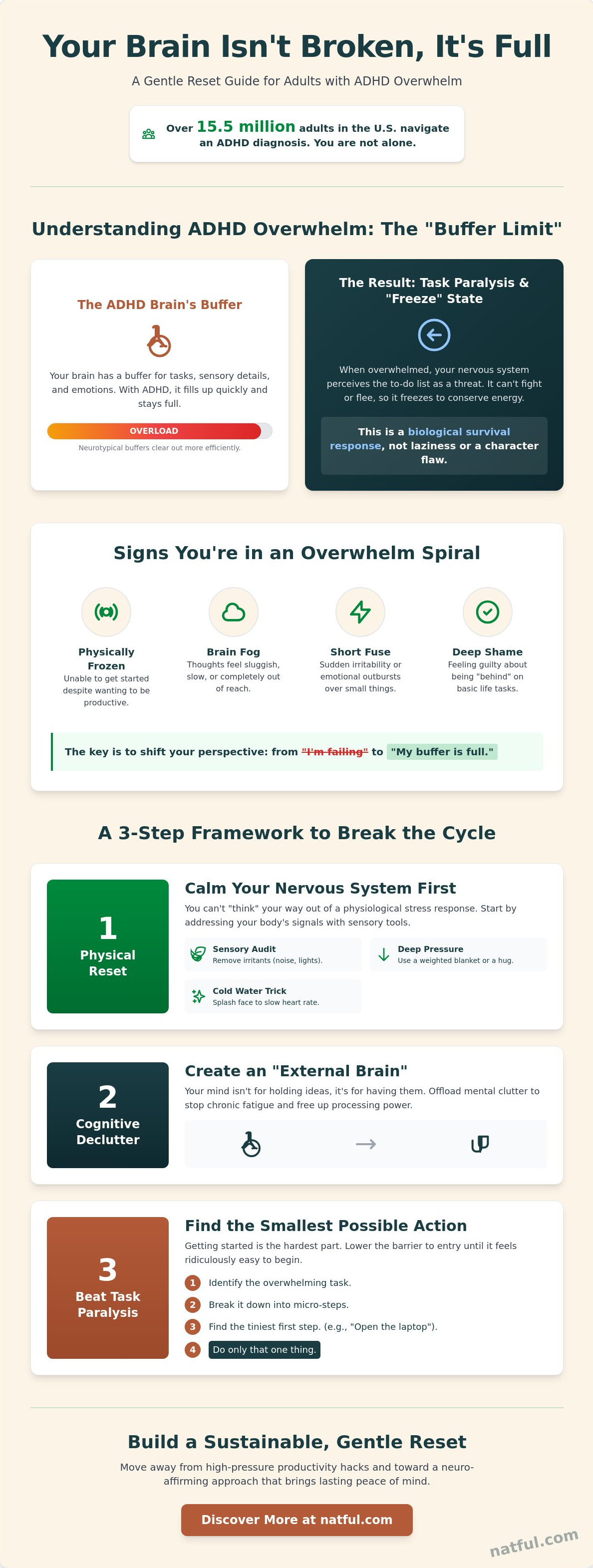
ADHD overwhelm is much more than just having a busy schedule. It is a specific state of total cognitive and emotional saturation where your mind simply stops processing new information. Imagine your brain has an internal buffer; a temporary storage space for every incoming sensory detail, task, and emotion. For neurotypical individuals, this buffer clears out efficiently. However, for those seeking adhd overwhelm tips for adults, the experience is quite different. The buffer fills up quickly and stays full. When this happens, even the smallest decisions, like choosing which email to answer first, can feel as monumental as climbing a mountain.
When you feel paralyzed by your to-do list, your body has likely entered a "freeze" state. This is a primitive survival mechanism. Your nervous system perceives the overwhelming volume of tasks as a literal threat to your safety. Because you cannot fight the tasks or flee from your responsibilities, your brain shuts down to conserve energy. This is not laziness. It is a biological protection at work. You cannot shame a survival response into disappearing; you have to work with your biology to reset it.
The Role of Executive Dysfunction
Executive dysfunction is the technical reason why your brain's "manager" seems to go on strike during stressful times. This manager is responsible for prioritizing, starting, and switching between tasks. When you have ADHD, these processes consume a massive amount of mental energy. Starting a task is often the hardest part because your brain cannot decide where the "beginning" actually is. Your brain is not broken. It is simply overloaded. To understand the biological foundations of these challenges, it helps to look at the clinical reality of What is Adult ADHD?. It is a neurological difference that requires specific tools, not just more effort.
Signs You Are in an Overwhelm Spiral
Recognizing the spiral early is the first step toward a successful reset. You might notice physical tension in your shoulders or a sudden spike in irritability over small background noises. Often, the brain attempts to protect itself through "doom scrolling" or other forms of mindless escape. This is your nervous system trying to find a low-stimulus environment to prevent further saturation. Identifying these signs allows you to apply adhd overwhelm tips for adults before you hit total burnout.
Common signs of an impending spiral include:
- Feeling physically frozen or unable to get off the couch despite "wanting" to work.
- A sense of "brain fog" where thoughts feel sluggish or unreachable.
- Sudden emotional outbursts or a "short fuse" with loved ones.
- Deep shame about being "behind" on basic life tasks like laundry or dishes.
This state is fundamentally different from simple stress. True neurodivergent burnout happens when that internal buffer has been overflowing for too long without a proper reset. By shifting your perspective from "I'm failing" to "my buffer is full," you create the space needed to begin the recovery process.
The Physical Reset: Calming Your Nervous System First
When you are deep in a state of neurodivergent freeze, your prefrontal cortex is effectively offline. This is why you cannot "think" your way back to focus. Logic doesn't work when your body is flooded with cortisol. Your nervous system is screaming that you are in danger, even if the "threat" is just a pile of unopened mail. To regain control, you must treat this as a physiological event rather than a mental failure. Physical regulation is the most effective of all adhd overwhelm tips for adults because it bypasses the "stuck" thoughts and speaks directly to your biology.
Start with a five-minute sensory audit. Close your eyes and listen. Is the hum of the refrigerator grating on your nerves? Is your clothing too tight or scratchy? We often ignore these minor irritants until they overflow our internal buffer. Identifying and removing these hidden stressors lowers your baseline agitation immediately. Another powerful tool is proprioceptive input. This involves activities that provide deep pressure to your muscles and joints. It tells your brain exactly where your body is in space, which provides an instant sense of grounding and safety.
Lowering the Sensory Ceiling
Your environment acts as a "ceiling" on your focus. If that ceiling is too low due to noise or bright lights, your brain feels trapped. Put on noise-canceling headphones or dim the lights to give your nervous system a break. If you feel a spiral coming on, try the cold water trick. Splashing ice-cold water on your face triggers the mammalian dive reflex, which naturally slows your heart rate and resets your stress response. These practical tips for managing ADHD help clear the immediate fog so you can breathe again. Even clearing just one square foot of your desk can provide enough visual "breathing room" to stop the panic.
Movement as a Reset Tool
Stagnant energy often manifests as physical tension or a desperate need to "flee" the room. Instead of fighting it, discharge that energy through intentional movement. Try doing ten wall pushes or a few vigorous jumping jacks. You can also try the "shake it off" method. Literally shake your arms and legs as if you are trying to flick water off your skin. This simple act releases pent-up tension in the muscles. Motion creates emotion; shifting your body shifts your mind. If you find yourself constantly hitting this wall, you might benefit from a more structured approach like The Complete Reset Bundle™ to help manage these daily transitions. By moving your body, you signal to your brain that the "threat" has passed and it is safe to return to a state of calm focus.
Cognitive Decluttering: Strategies to Offload Your Brain
Mental fatigue isn't just about being tired. It is about the weight of unmanaged data. For an adult with ADHD, holding onto a dozen half-formed plans is like running too many programs on an old computer. It slows everything down until the system crashes. This internal "holding" is the primary cause of cognitive exhaustion. To break the cycle, you need a strict "external brain" policy. If a thought enters your mind, it must be moved to a reliable external system immediately. This is one of the most vital adhd overwhelm tips for adults because it stops the drain on your executive functions before it starts.
There is a crucial difference between capturing information and planning your life. Capturing is messy. It is fast. It's about getting the thought out of your head before it disappears or becomes a source of anxiety. Planning is the separate act of deciding when and how to do those things. When you try to do both at once, you trigger the "freeze" response we discussed earlier. By separating these two acts, you allow your brain to breathe. You aren't deciding what to do yet; you're just making sure you don't forget. This separation is a core part of a non-judgmental framework for productivity.
The 10-Minute Brain Dump
Think of a brain dump as a daily hygiene ritual. Set a timer for ten minutes and write without stopping. Don't worry about grammar or importance. Get the "I need to buy milk" out alongside "I'm worried about my career." Once the timer stops, look at your list with compassion. Use a simple three-way filter: "Now," "Later," and "Never." The "Never" list is your secret weapon. It is where you give yourself permission to let go of tasks that no longer serve you. Seeing these items outside of your own skull makes them manageable. They are no longer a giant, looming threat; they are just data on a page.
Tools for Seamless Capture
Your capture system must be easier than trying to remember. If it feels like "work," your brain will resist it. Voice-to-text apps are a lifeline for when typing feels like too much effort. You can speak your thoughts into existence while walking or doing the dishes. For transient thoughts that don't need a permanent home, a simple sticky note strategy works wonders. If you need a more structured approach to stop the chaos, the Digital Guides Collection provides neuro-affirming frameworks designed to help you organize your life without the shame. These tools act as a steady hand, guiding you toward a cleaner mental slate. By offloading the "holding" process, you return to a state of foundational strength and clarity.
A Step-by-Step Checklist for Task Paralysis
Task paralysis isn't a failure of character or a lack of discipline. It is a neurological traffic jam. When your brain perceives a to-do list as a series of threats rather than a series of actions, it chooses to freeze to protect you. This is where practical adhd overwhelm tips for adults move from theory into a survival strategy. You must lower the barrier to entry until it is almost impossible to fail. This starts with the concept of the Minimum Viable Action (MVA). An MVA is the smallest possible iteration of a task. Instead of "cleaning the kitchen," the MVA is "placing one plate in the dishwasher." It sounds small, but it works because it bypasses your brain's threat-detection system.
Once you break the initial freeze, you must protect your focus with the 3-Task Rule. Your brain cannot process twenty priorities at once. Pick three. Write them down. Hide the rest of the list. By limiting your field of vision, you reduce the background noise that causes cognitive fatigue. Use an external timer, like the Pomodoro technique, to act as a "body double" for your focus. Knowing that a break is coming helps you stay present in the work. Remember the mantra: Done is better than perfect. Perfectionism is often just a shield against the fear of being "wrong."
Breaking the Freeze: The 5-Minute Rule
Starting is the hardest part for the ADHD brain. The friction of beginning a task is where most of us get stuck. To beat this, commit to working for only five minutes. Tell yourself you can stop when the timer dings. Usually, once the momentum starts, the brain finds it easier to keep going. If five minutes feels like too much, try the one-minute rule. Pick one action. A small win is still a win; momentum is your greatest ally.
The "Just One Thing" Framework
This framework is designed to stop the brain from scanning for new threats by narrowing your focus to a single point of impact. It creates a sense of safety that allows your executive functions to come back online.
- Step 1: Pick the smallest, easiest task on your list.
- Step 2: Clear your immediate workspace of everything else.
- Step 3: Set a timer for 15 minutes and focus only on that one item.
When you finish, give yourself a dopamine hit. Listen to a favorite song or have a small snack. This reward system is essential for reinforcing the habit of finishing. If you struggle with the chaos of big transitions or high-pressure days, the Neurodivergent Adults Getting Ready For Events Without Overwhelm Ebook provides a structured path to handle those moments without the spiral. By celebrating these small victories, you begin to rewire your brain's relationship with productivity.
Building a Sustainable Reset: The Holistic Path
Maintaining clarity is an ongoing journey, not a one-time fix. While immediate resets provide relief, long-term stability requires a more intentional approach. This is where sustainable adhd overwhelm tips for adults transition from emergency tools into daily rituals. A Weekly Reset acts as your scheduled clean break from the noise. It is a time to return to basics, clear the cognitive buffer we discussed earlier, and prepare your nervous system for the week ahead. Consistency is not about being perfect. It is about the grace of returning to your center every time you drift away.
Think of your focus as a finite resource that needs constant replenishment. You cannot expect a car to run without fuel, yet we often expect our ADHD brains to perform without proper physiological support. By treating your physical and mental health as interconnected parts of a natural whole, you reduce the frequency of total burnout. You are not a machine that needs fixing; you are a living system that needs alignment. This holistic perspective moves you away from high-pressure productivity and toward a state of foundational strength.
Foundational Strength: Nutrition and Clarity
Your brain is a biological organ. It requires foundational strength to function. Physical wellbeing, including proper hydration, high-quality protein, and essential minerals, directly supports your cognitive clarity. When the body is depleted, the ADHD brain struggles even more to regulate emotions and focus. The Natful approach focuses on nourishing the body to support the mind. For instance, incorporating Natful Hydrolyzed Bovine Collagen Peptides Powder can be part of a daily routine that reinforces your systemic balance. By providing your body with Vitamin C, B3, and Zinc, you are building a stronger floor for your mental health to stand on.
Your Long-Term ADHD Toolkit
Having the right tools makes the journey toward alignment feel possible. For specific high-pressure moments, the Neurodivergent Adults Getting Ready For Events Without Overwhelm Ebook offers a non-judgmental framework for managing transitions. If you are balancing your own neurodivergence with the demands of a family, the Calm Parenting Reset™ provides strategies to handle hard moments without losing control. These resources are designed to reduce friction and provide the gentle coaching you need to stay grounded.
True change happens when you stop fighting your biology and start working with it. By combining sensory regulation, cognitive offloading, and foundational nutrition, you create a life that feels manageable. Ready to reclaim your focus? Explore The Complete Reset Bundle™ and finally feel in control of your day-to-day life. You are not broken. You are simply building a better way to live.
Reclaiming Your Calm and Clarity
You now have a roadmap to navigate the fog of executive dysfunction. Remember that overwhelm is a biological signal, not a character flaw. By prioritizing nervous system regulation and offloading mental clutter to an external system, you protect your internal buffer from reaching its limit. These practical adhd overwhelm tips for adults help you work with your biology rather than against it. Momentum starts with the smallest possible action. You don't need to do everything at once; you just need to return to basics.
If you are ready for a structured path toward alignment, our neuro-affirming resources provide the steady hand you need. The Complete Reset Bundle™ is specifically crafted to help you handle hard moments without losing control. It combines holistic wellness products that support the body-mind connection with digital guides tailored for neurodivergent adults. Stop feeling overwhelmed and finally feel in control with The Complete Reset Bundle™. You deserve to move through your day with a sense of quiet authority and foundational strength. Your journey toward a more peaceful life begins with a single, gentle reset.
Frequently Asked Questions
Why do I feel so overwhelmed by simple tasks as an adult with ADHD?
You feel overwhelmed because your brain's executive functions struggle to prioritize the micro-steps involved in "simple" tasks. For a neurodivergent mind, washing a dish isn't one action; it's a series of decisions about water temperature, soap, and drying space. This cognitive load fills your internal buffer quickly. When the buffer is full, your system enters a state of saturation that makes even small starts feel impossible.
How can I stop ADHD paralysis when I have a long to-do list?
To stop paralysis, you must shrink your field of vision immediately. A long list is often perceived as a threat by your nervous system, triggering a freeze response. Pick one tiny action, like opening a laptop or moving one item. Use external timers to act as a "body double" for your focus. These adhd overwhelm tips for adults work because they lower the starting friction and allow momentum to take over.
What is the "wall of awful" in ADHD, and how do I get past it?
The "wall of awful" is the emotional barrier of shame, guilt, and past failure that builds up around a task. You don't get past it by trying harder; you get past it by putting "doors" in the wall. This means acknowledging the emotion first and using sensory tools to calm your heart rate. Once the emotional intensity drops, the task becomes a simple action again rather than a moral failure.
Can sensory overload cause ADHD overwhelm?
Yes, sensory overload is a primary driver of cognitive saturation. Your brain doesn't filter out background noise, bright lights, or physical discomfort as effectively as others. This constant stream of data consumes the mental energy needed for focus. Lowering the "sensory ceiling" with noise-canceling headphones or dimmed lights is one of the most effective ways to prevent your internal buffer from overflowing into a full-blown spiral.
What are the best immediate tips for ADHD burnout?
The best immediate response to burnout is a total sensory reset. Stop trying to be productive and focus on physiological safety. Use the cold water trick to shock your nervous system into a calmer state or lie on the floor to feel grounded. Burnout is a signal that your system is depleted. Recovery requires nourishing your body and giving yourself permission to do nothing until your baseline energy returns.
How does the "brain dump" technique help with neurodivergent stress?
The brain dump helps by offloading the high "holding cost" of unmanaged information. Your brain uses massive amounts of energy trying not to forget things. Moving those thoughts to paper clears your mental workspace immediately. It transforms a vague cloud of anxiety into a concrete list of data points. Once you see the tasks outside of your own skull, they stop feeling like a looming threat to your safety.
Is there a specific diet or supplement that helps with ADHD focus?
While there is no "magic pill," foundational nutrition supports cognitive clarity. A diet high in protein and essential minerals helps maintain steady energy levels. Supplements like Natful Hydrolyzed Bovine Collagen Peptides Powder provide Vitamin C, B3, and Zinc, which support the body-mind connection. Ensuring your physical system is nourished creates a more stable floor for your mental focus, making adhd overwhelm tips for adults more effective long-term.
How do I explain my ADHD overwhelm to my partner or boss?
Explain it as a biological capacity issue rather than a lack of effort. Use the analogy of a computer with too many programs running at once. Tell them, "My internal buffer is currently full, and I've reached a state of sensory saturation." This shifts the conversation from your character to your needs. Ask for specific accommodations, like written instructions or a quiet workspace, to help you clear the fog and return to focus.



Leave a comment
This site is protected by hCaptcha and the hCaptcha Privacy Policy and Terms of Service apply.