
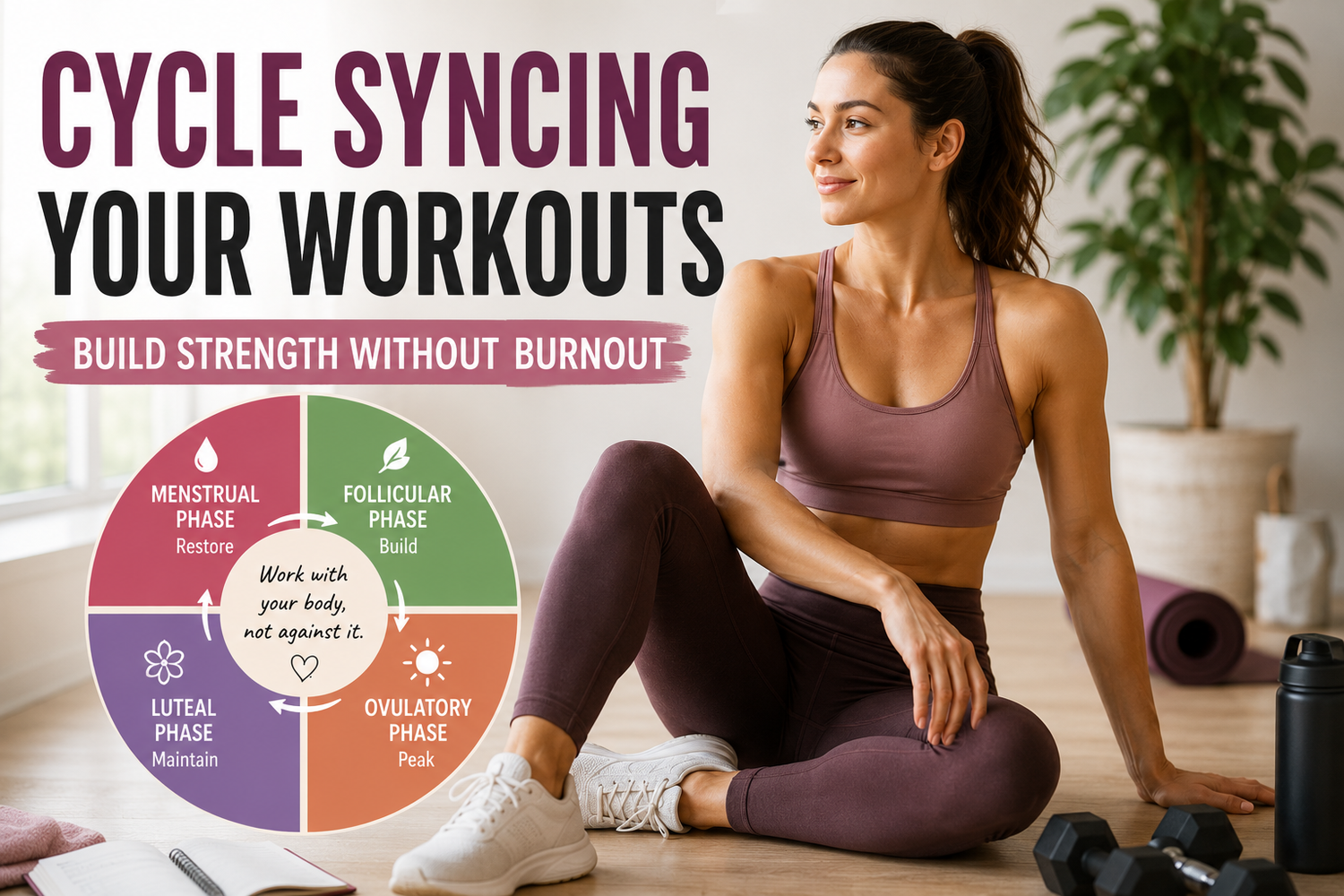
Cycle Syncing Your Workouts: Build Strength Without Burnout
Then another week arrives and the same workout feels strangely harder. Your legs feel heavy. Your motivation disappears. You push through anyway because you don’t want to “fall behind,” but afterward you feel drained instead of proud.

If that sounds familiar, you are not lazy. You may simply be training like your body is the same every day — when, for many women, it is not. That is where cycle syncing fitness comes in.
Cycle syncing is the practice of adjusting parts of your lifestyle — including exercise — around the natural shifts of your menstrual cycle. For workouts, the goal is not to obsess over hormones or follow a rigid calendar. It is to build a smarter rhythm: push when your body feels ready, maintain when energy is steady, and recover before burnout catches up with you.
And here is the important nuance: research does not prove that every woman must train differently in each cycle phase. A 2023 umbrella review published in Frontiers in Sports and Active Living found that current evidence does not show a clear, consistent effect of menstrual cycle phase on strength performance or resistance training adaptations. In other words, your cycle is not a weakness, and you do not need to avoid hard training just because of where you are hormonally.
But science and lived experience can both be true. Many women notice predictable changes in energy, sleep, mood, cramps, bloating, motivation, or recovery. Cycle syncing gives you a flexible way to respond to those patterns without quitting your routine. Think of it less as “hormone rules” and more as body-aware programming.
What Is Cycle Syncing Fitness?

Cycle syncing fitness means matching the intensity, style, or recovery demands of your workouts to how you tend to feel across your menstrual cycle.
A typical menstrual cycle is often described in four parts:
• Menstrual phase — when bleeding occurs
• Follicular phase — the days after your period, leading up to ovulation
• Ovulatory phase — the short window around ovulation
• Luteal phase — the days after ovulation and before your next period
Cleveland Clinic explains that estrogen rises during the follicular phase, ovulation happens around mid-cycle for many women, and progesterone becomes more dominant during the luteal phase. These hormonal shifts can influence how some women feel physically and emotionally, though the experience varies widely.
A cycle syncing exercise plan uses those patterns as helpful information — not as a strict command. For example, if you usually feel strong and energized after your period, that may be a good time to schedule heavier strength training. If the week before your period often comes with fatigue, breast tenderness, sleep changes, irritability, or cravings, that may be the week to reduce intensity, increase recovery, and focus on consistency over personal records.
This approach is especially relevant today because the wellness conversation is shifting away from punishment-based fitness. Women are tired of programs that demand maximum output every day. Sustainable fitness is becoming more intentional, personalized, and recovery-aware — and that is good news for women over 30, 40, and beyond.
The Big Mistake: Treating Every Week Like Peak Week

Many fitness plans are designed as if your energy, sleep, stress, hormones, and recovery capacity are constant. Monday is leg day. Tuesday is intervals. Wednesday is upper body. Thursday is another high-intensity class. Repeat forever.
That structure can work for some people. But for many women — especially those juggling work, caregiving, relationships, perimenopause changes, or high stress — it can become a fast track to burnout.
Burnout does not always look dramatic. Sometimes it looks like:
• Dreading workouts you used to enjoy
• Feeling sore for longer than usual
• Needing more caffeine to get moving
• Losing motivation before your period
• Getting stuck in an “all or nothing” pattern
• Skipping workouts because the plan feels too intense
• Feeling guilty instead of supported by exercise
A cycle syncing approach helps you stop seeing lower-energy days as failure. Instead, you learn to adjust the dose.
You are still training. You are simply training with better timing.
Phase 1: Menstrual Phase — Restore, Move Gently, Reduce Pressure

Typical timing: Days 1–5 (though this varies)
Possible experience: Bleeding, cramps, fatigue, lower motivation, relief from PMS, desire for slower movement
During your period, your body may ask for a softer start. Some women feel completely fine training hard during menstruation, and that is okay. Others feel depleted, crampy, or emotionally sensitive. The goal is to listen without judgment.
Good workout options during the menstrual phase:
• Gentle walking
• Mobility work
• Stretching or yoga
• Light strength training
• Pilates-style core work, if comfortable
• Easy cycling or swimming
• Rest days, especially during heavier flow
If you love strength training, you do not have to stop. Just consider reducing one variable: lighter weights, fewer sets, slower tempo, or longer rest between sets.
Try this simple rule: leave the workout feeling better than when you started. That might mean 20 minutes instead of 50. It might mean walking outdoors instead of a high-intensity class. This is not weakness. It is energy management.
Phase 2: Follicular Phase — Build Momentum and Strength

Typical timing: After your period until ovulation
Possible experience: Rising energy, better mood, more motivation, improved confidence, easier recovery
For many women, the follicular phase feels like a fresh start. Energy may rise, motivation may return, and workouts may feel more enjoyable. This can be a great time to gradually increase intensity.
Good workout options during the follicular phase:
• Strength training with progressive overload
• Moderate-to-challenging cardio
• New fitness classes
• Hill walks or interval walking
• Heavier lower-body or full-body workouts
• Skill-based training, like learning a new lift
If your body feels good, this is the phase where you might aim for progress: one extra rep, slightly heavier dumbbells, a longer walk, or a new personal best. For women over 30 and 40, strength training is one of the most valuable long-term investments for muscle, metabolism, posture, bone health, and confidence.
Phase 3: Ovulatory Phase — Channel Power, But Warm Up Well

Typical timing: Around mid-cycle
Possible experience: Higher energy, social confidence, strong workouts, sometimes mild ovulation pain or sensitivity
Around ovulation, some women feel powerful and energetic. This can be a good window for challenging workouts, especially if sleep and stress are also in a good place.
Good workout options during ovulation:
• Heavier strength training
• Short interval sessions
• Dance cardio
• Athletic circuits
• Faster walks or runs
• Group classes that feel motivating
Because this phase can feel like a natural “peak,” it is tempting to go all in. That can be fine — but do not skip your warm-up. A good warm-up helps your nervous system, joints, and muscles prepare for intensity.
Phase 4: Luteal Phase — Maintain, Modify, and Protect Recovery

Typical timing: After ovulation until your next period
Possible experience: Steady energy early on, then PMS symptoms: fatigue, mood changes, bloating, cravings, sleep disruption, lower motivation
The luteal phase is where many women benefit most from cycle-aware training. Progesterone rises after ovulation, and some women notice they feel warmer, more tired, hungrier, or less tolerant of very intense workouts.
This does not mean you cannot train. Regular aerobic exercise may help PMS symptoms such as fatigue and low mood, according to the Office on Women’s Health and ACOG. But this may be the phase to shift from “push” to “support.”
Good workout options during the luteal phase:
• Moderate strength training
• Zone 2 cardio or brisk walking
• Pilates
• Yoga
• Mobility and stretching
• Lower-impact circuits
• Shorter workouts with longer rest
A helpful luteal phase strategy is to divide it into two parts:
• Early luteal: Early luteal: Keep training normally if you feel good.
• Late luteal: Late luteal: Reduce intensity by 10–30% if PMS, poor sleep, cravings, or irritability show up.
A Simple Cycle Syncing Exercise Plan

Cycle Phase
Training Focus
Best Workouts
Intensity
Menstrual
Restore and gently move
Walking, mobility, yoga, light strength
Low to moderate
Follicular
Build momentum
Strength training, moderate cardio, new classes
Moderate to high
Ovulatory
Use power wisely
Heavier lifts, intervals, athletic workouts
Moderate to high
Luteal
Maintain and recover
Moderate strength, walking, Pilates, yoga
Moderate, then lower if PMS appears
If you want a weekly structure, try this:
• 2–3 strength sessions per week
• 2–4 walking or cardio sessions per week
• 1–2 mobility or recovery sessions per week
• At least 1 true rest day per week
Then adjust intensity based on your phase.
7 Actionable Tips to Make Cycle Syncing Work in Real Life

1. Track energy, not just dates
Apps can be helpful, but your body’s signals matter most. For two or three cycles, track simple notes: energy, mood, sleep, cramps, cravings, workout performance, and motivation.
2. Use a “traffic light” workout system
Before training, ask: am I green, yellow, or red today?
• Green: Green: Energy is good. Train as planned.
• Yellow: Yellow: Energy is okay but not amazing. Reduce intensity slightly.
• Red: Red: Pain, exhaustion, poor sleep, or heavy symptoms. Choose recovery or gentle movement.
3. Keep strength training in the plan
Cycle syncing should not become an excuse to avoid strength work for half the month. Muscle matters deeply for aging well. Keep strength training consistent while adjusting load, volume, and recovery.
4. Plan your hardest workouts when you usually feel best
If you notice your best energy comes after your period, schedule your more demanding strength days there. If your best days are different, trust your own pattern.
5. Stop punishing PMS with harder workouts
When PMS hits, some women try to “discipline” themselves with more intense exercise. Sometimes movement helps. But if a brutal workout leaves you depleted, try a walk, moderate lift, or gentle mobility instead.
6. Fuel your workouts, especially in the luteal phase
Under-eating can make cycle-related fatigue feel worse. Prioritize protein, fiber-rich carbohydrates, healthy fats, and hydration.
7. Give yourself a minimum baseline
On low-energy days, your baseline might be a 10-minute walk or five minutes of stretching. This protects the habit without creating guilt.
What If You Are in Perimenopause or Have Irregular Cycles?

Cycle syncing can still be useful, but you may need to focus less on calendar phases and more on symptom patterns. During perimenopause, cycles can become shorter, longer, heavier, lighter, or less predictable.
Instead of asking, “What phase am I in?” ask:
• How did I sleep?
• Is my stress high?
• Do I feel strong, steady, or depleted?
• Am I recovering from my last workout?
• Do I need intensity or restoration today?
If your periods are very painful, extremely heavy, suddenly irregular, or interfering with daily life, it is worth speaking with a qualified healthcare professional. Cycle syncing is a fitness strategy, not a medical treatment.
The Bottom Line
Cycle syncing your workouts is not about limiting yourself. It is about building a fitness routine that respects your real life, real energy, and real body.
Some days, strength means lifting heavier. Other days, strength means choosing the walk, stretching your hips, going to bed earlier, and coming back tomorrow.
The most effective workout plan is not the one that looks perfect on paper. It is the one you can keep returning to without burning out.
So this month, try a softer experiment: track your energy, notice your patterns, and adjust one or two workouts around your cycle. You do not need to overhaul everything. You just need to stop fighting your body long enough to work with it.
Want more natural wellness routines for strength, energy, and healthy aging? Join the Natful email list for weekly, science-backed tips designed for women 30+.
Sources
Cleveland Clinic: Menstrual cycle phases — https://my.clevelandclinic.org/health/articles/10132-menstrual-cycle
Cleveland Clinic: Nutrition and exercise throughout your menstrual cycle — https://health.clevelandclinic.org/nutrition-and-exercise-throughout-your-menstrual-cycle
PubMed: Menstrual cycle phase and resistance training evidence review — https://pubmed.ncbi.nlm.nih.gov/37033884/
Office on Women’s Health: PMS and exercise — https://womenshealth.gov/menstrual-cycle/premenstrual-syndrome
ACOG: Premenstrual Syndrome FAQ — https://www.acog.org/womens-health/faqs/premenstrual-syndrome
CDC: Adult physical activity guidelines — https://www.cdc.gov/physical-activity-basics/guidelines/adults.html



Leave a comment
This site is protected by hCaptcha and the hCaptcha Privacy Policy and Terms of Service apply.